
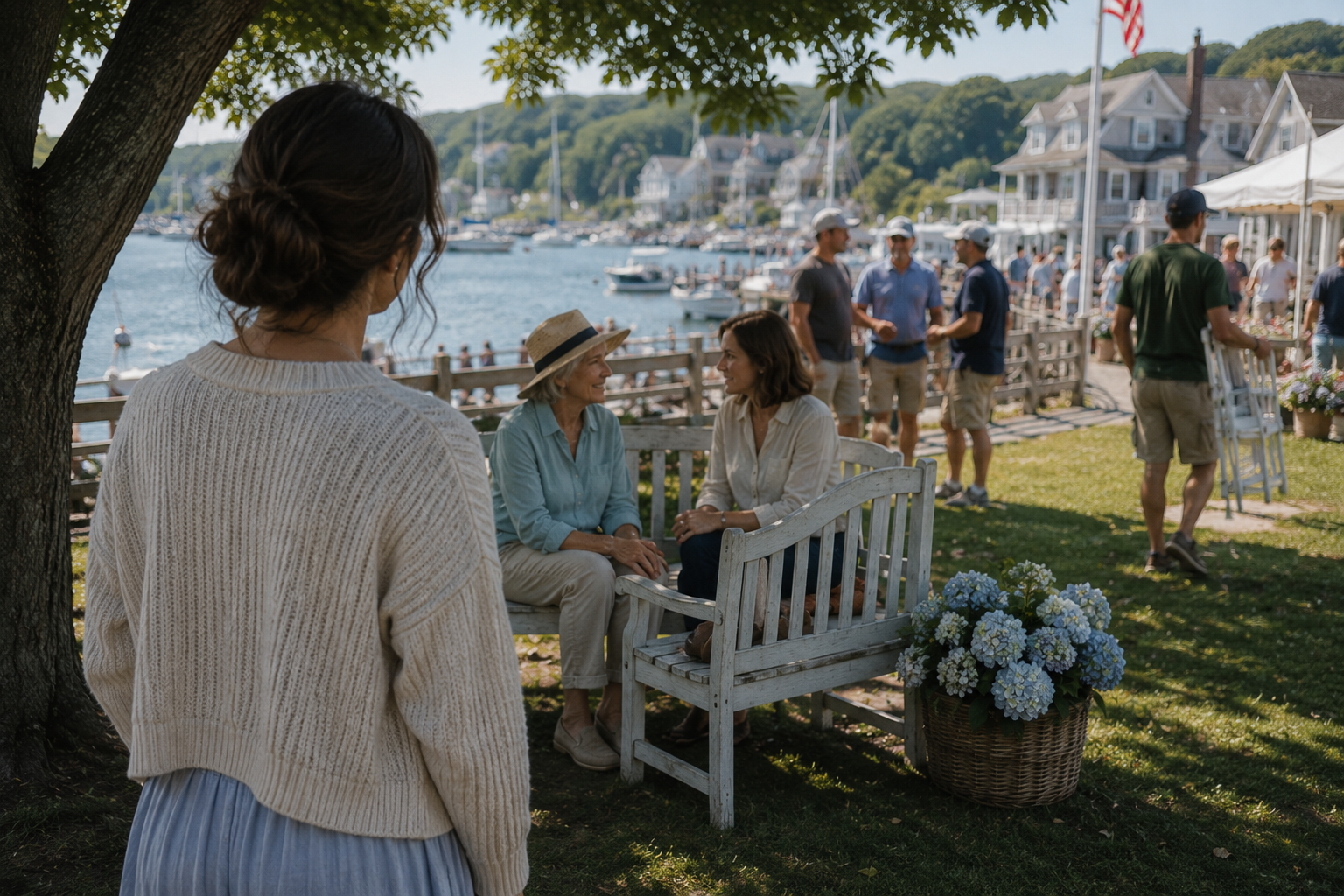
Emma woke before the cottage had fully gathered the morning.
For a few seconds she stayed where she was, listening through the open window to the soft drag of the tide beyond the neighboring houses and the first gulls calling over the harbor. The air coming in smelled faintly of salt, damp grass, and the roses climbing along the side fence.
Founders Day.
The words came to her before her feet touched the floor.
She had heard people speak of it for weeks now, at the bakery, outside the general store, along the harbor where men leaned against railings and discussed weather as though it were a personal matter. Lilly had been working on flower arrangements. Clara had pulled old island history books into the front window of the bookshop. Mabel had been baking long before the sun came up for three mornings in a row. Even Duke, who claimed he did not care for crowds, had spent half the week helping repair booths that only appeared once a year.
Emma had told herself she was looking forward to it, and she meant it.
But waking inside her grandmother’s cottage, with her parents asleep down the hall and the whole town beginning to stir beyond the windows, she felt something deeper than anticipation. It sat low in her chest, warm and tender, like the first sip of coffee on a slow morning.
She dressed in a light blue cotton dress and a cream cardigan, then moved through the hallway with the careful steps of someone trying not to wake a house too soon. The guest room door was still closed. Her father had slept there, though he had teased the night before that the bed was too soft and he might be ruined for his own mattress at home. Her mother had smiled at him over her tea and said the ocean air would have him asleep before he finished complaining.
She had been right.
In the kitchen, Emma filled the kettle and set it on the stove, then reached for the coffee tin her grandmother had kept in the same cabinet for as long as Emma could remember. The tin was new now, something Emma had bought herself after the old one had finally rusted along the bottom, but she kept it in the same place because certain small things felt worth preserving.
The kettle began to warm.
Outside, the morning brightened by degrees.
She opened the back door and stepped onto the porch, wrapping both hands around her mug once the coffee was made. Across the lane, Mrs. Bellamy was hanging red, white, and blue bunting across her porch rail while her husband stood below giving instructions nobody seemed to need. Farther toward town, a boy rode past on a bicycle with streamers already tied to the handlebars, one loose ribbon trailing behind him like a fish line caught in the wind.
Emma smiled into her coffee.
By eight o’clock, everyone had started to wake.
Her mother appeared first, wearing linen pants and a pale sweater, her hair pinned back in the loose way she wore it on vacation mornings. She paused in the kitchen doorway, blinking toward the window.
“This house gets the prettiest light,” she said.
Emma turned from the counter where she was slicing peaches beside a plate of blueberry muffins she had bought from Mabel the afternoon before.
“It always did in summer.”
Her mother crossed the kitchen and rested a hand on the back of one of the chairs.
“I can see why your grandmother loved mornings here.”
“She did most of her thinking before breakfast.”
Emma nodded. “She did.”
Emma set the peaches into a bowl. “Dad still asleep?”
“For once, yes.”
As though summoned by the mention of him, her father’s voice came from the hallway.
“I heard that.”
Her mother looked toward Emma with the pleased expression of someone who had won a small private bet.
He came in wearing khaki shorts and a navy shirt, his hair still damp from the shower, his face less tired than it had looked when he arrived the day before. He stopped near the doorway and breathed in.
“Now that,” he said, pointing toward the muffins, “is why people should travel more.”
Emma laughed. “Mabel made them.”
“The bakery woman?”
“Yes.”
“I already like her.”
“You haven’t met her yet.”
“I can’t wait to meet her and thank her for these muffins,” he said.
They ate at the kitchen table with the windows open.
Her father put butter on his muffin as though it were his duty to honor it properly. Her mother asked whether the church would be open during the day, and Emma told her there would be a historical display in the fellowship hall. Old photographs. Handwritten records. A few stories about the families who had first settled along the harbor.
“Your grandmother would have loved that,” her mother said.
“She probably helped label half of it.”
Emma’s father looked up. “Wouldn’t surprise me.”
The mention of Margaret did not pull the room into sadness. Not exactly. It settled over the table the way morning light settled across the floor, present but not heavy. Emma had learned over time that grief could do that. It could sit among ordinary things without taking them away.
After breakfast, they took their time clearing plates and rinsing cups. Her mother insisted on washing. Her father dried, though he complained that there were not enough towels. Emma stood between them, putting things back where they belonged.
For a moment, she saw herself as a child again, standing in this same kitchen while adults moved around her, their voices crossing over one another, their hands busy with dishes, fruit, crumbs, coffee. Back then she had believed grown people always knew what came next. Now she understood most of them had only been doing the best they could with whatever the day placed in front of them.
By midmorning, they were walking toward town.
The island seemed to have dressed itself for company.
Flags moved from porch posts and shop windows. Baskets of flowers hung from iron hooks outside the bakery. The white church at the corner wore garlands along its railings, and a table had been set near the steps with pitchers of water, paper fans, and a handwritten sign welcoming visitors. Children ran ahead of their parents, shoes scuffing against the pavement, their cheeks already pink from heat and excitement.
Emma’s father slowed near the harbor road.
“Well,” he said, looking around, “they don’t do this halfway.”
“No,” Emma said. “They really don’t.”
Her mother slipped her arm through Emma’s. “It feels like one of those towns in an old photograph, except everyone is still moving.”
That was exactly it, Emma thought.
Nothing felt staged. Nothing felt arranged for people passing through with cameras and tote bags. The celebration seemed to have risen from the place itself, from the boards of the docks and the clapboard houses, from the names on mailboxes and the hands that had painted signs, baked pies, hauled tables, and swept porches before anyone arrived to admire them.
They had not gone far before someone called Emma’s name.
Ruth was sitting near the church steps with two women Emma recognized from the spring market but could not yet name with confidence. Ruth wore a straw hat trimmed with navy ribbon and held a paper fan in one hand, flicking it against the warm air.
“There you are,” Ruth said, her face brightening. “And these must be your parents.”
Emma introduced them, and Ruth stood with more effort than she would have admitted needing. Her mother reached both hands toward her.
“I’ve heard so much about you,” she said.
Ruth laughed. “Only the good parts, I hope.”
“Of course.”
Ruth nodded toward the harbor. “Feels like she’s still part of things around here.”
Emma’s father shook Ruth’s hand, and Ruth looked past him to Emma.
“Your daughter has her eyes,” she said. “I expect you already know that.”
He looked at Emma again, and something in his expression softened around the edges.
“I do.”
Ruth patted Emma’s hand. “Go on now. Don’t spend the whole morning with old women and folding chairs. There’s music by the harbor, and Mabel will sell out of shortcake if you don’t make your way over.”
“That sounds urgent,” Emma’s father said.
“It is,” Ruth said, smiling.
Emma’s father glanced toward the bakery. “We’d better not delay then.”
They thanked her and moved with the crowd toward Mabel’s booth.
The center of town had become a patchwork of tables, tents, and voices. Near the bakery, Mabel stood behind a booth covered in pies, muffins, wrapped loaves, and rows of strawberry shortcake layered in clear cups. Flour dusted one sleeve of her dress, and a pencil held her hair in place above her neck.
“Emma Winslow,” Mabel called, “you brought reinforcements.”
Emma laughed. “Yes, my parents are visiting.”
Mabel leaned forward across the table. “Then you both need shortcake before the tourists discover I made extra whipped cream.”
Her father placed one hand over his heart. “Ma’am, I respect a woman with priorities.”
Mabel laughed, the pencil in her hair slipping a little. “I like him.”
Emma smiled. “That’s funny. My father said the same thing about you this morning before he’d even met you. He was pretty sure anyone who could make muffins like those was someone he wanted to meet.”
Her father smiled. “And I stand by that.”
Her mother chose shortcake. Her father added a slice of blueberry pie for later, which Mabel wrapped in paper and tied with string despite his claim that later might only mean ten minutes from now.
They ate standing near the side of the bakery while people moved around them in waves. Emma watched her parents take it in: the ease of people greeting one another, the way children were watched by everyone without being hovered over by anyone, the older men gathered near the marina with coffee cups in hand, the teenagers selling lemonade with a seriousness that made their handwritten price sign seem official.
A little farther down, Clara had set a table outside the bookshop. Stacks of island histories, used paperbacks, and children’s books sat beneath a striped umbrella. A chalkboard read, Stories Belong Somewhere.
Emma stopped when she saw it.
Clara looked up from tying twine around a bundle of bookmarks. “There you are.”
“I love your sign.”
“I thought you might.”
Emma introduced her parents, and Clara gave them the warm, reserved smile of someone who had spent a life noticing what people reached for before they said a word.
“Margaret used to come in every Founders Day,” Clara said. “She always bought one book she said she did not need.”
Emma’s mother touched the top book on the table. “That sounds exactly like her.”
“She claimed books did not count as clutter if they had good sentences.”
Emma felt a small laugh rise through her.
Her father nodded toward the window. “I may agree with her.”
Clara’s eyes moved toward him. “Then you should come inside before you leave today. I have a shelf that gets people into trouble.”
“That sounds dangerous,” he said, laughing.
“It is,” Clara replied, smiling.
They promised to return and continued toward the harbor, where the festival opened wider.
A small band played beneath a tent near the water, fiddle and guitar carrying above the murmur of the crowd. Children had gathered for a sack race in the grass beside the marina office. A line had formed outside the fire department’s barbecue booth, where smoke curled into the bright air and made everyone turn their heads with hungry interest. Near the old memorial marker, Lilly was putting the finishing touches on the flower arrangements. Every few moments she stepped back, tilted her head, then reached in to move a stem or two until she was happy with them.
When she saw Emma, she waved.
“You made it!”
Emma smiled. “We did.”
Lilly looked toward the couple beside her. “Well, who do we have here?”
Emma smiled. “My parents. They came for Founders Day.”
Lilly’s face brightened. “It’s so nice to meet you both. You picked a wonderful weekend to visit.”
Her mother looked at the flowers. “These are beautiful.”
“Thank you. I’ve been trying to make them look like they came from people’s gardens instead of a shop.”
Emma’s mother smiled. “You did a great job.”
“Thank you,” Lilly said. “That means a lot.”
Lilly glanced toward Emma.
“Ruth told me your grandmother always brought hydrangeas for the memorial table.”
Emma smiled. “She did. The bushes she planted along the fence are still blooming every summer.”
Lilly nodded. “I borrowed a few blooms from them this morning. I thought it was a nice way to have her be part of today.”
Emma looked from the arrangements to Lilly. “I think she would have loved that.”
Her mother smiled. “I think she would have too.”
Emma’s father looked over the flowers. “They’re beautiful.”
“Thank you,” Lilly said. “That means a lot.”
For the next hour, they wandered through the celebration, stopping wherever something caught their attention.
They watched the children’s bicycle parade, where streamers tangled in spokes and one little girl stopped mid-route because her paper crown had slipped over her eyes. They stepped inside the church hall, where old photographs lined the walls: fishermen standing beside enormous catches, women in long skirts gathered outside the original schoolhouse, children barefoot on the dock, the harbor frozen white during a winter cold enough to become a story.
Emma’s mother lingered over a photograph of Margaret as a young woman, standing beside Ruth and three other girls near the church steps. Margaret’s hair was pinned up, her head turned slightly away from the camera as if someone had called to her just before the picture was taken.
“There she is,” her mother said.
Emma stood beside her.
The photograph was slightly faded, but Emma could almost imagine the color of the day. The dark blue of the harbor beyond them. The bright sun on their faces. The pale dress Margaret would have chosen because it made her feel neat without trying too hard.
Her father came to stand on Emma’s other side.
“She looked happy,” he said.
“She did.”
An older man near the display turned when he heard them. “Margaret Winslow?”
Emma nodded. “She was my grandmother.”
The man’s face changed at once. “Well, I’ll be. She used to bring lemon bars to every church supper and tell us all they were too tart before we’d even tasted them.”
Emma laughed.
“She did that at home too.”
“They never were too tart.”
“No,” Emma said. “They were perfect.”
The man told them his name was Henry Calloway and that he had known Margaret for many years. He spoke about a storm one summer, about everyone gathering at the church when the power went out, about Margaret organizing candles, blankets, and coffee as if she had been born expecting emergencies.
Her mother listened with both hands clasped in front of her.
After he walked away, she looked at Emma. “There are whole parts of her life here I never saw.”
Emma nodded. “I’m still finding them.”
They left the church hall and stepped back into sunlight.
Near the harbor, Elias stood with his camera raised, photographing a group of children sitting on the edge of the dock with their feet hanging above the water. He lowered the camera when he saw Emma and grinned.
“Founders Day requires proof,” he said.
“Of what?”
“That everyone looked better in the morning than they will by supper.”
Elias laughed under his breath as he lowered the camera.
Emma introduced her parents, and Elias shook their hands with easy charm.
“I’ve heard your daughter has been adopted by the island,” he said.
Her father glanced at Emma. “Has she?”
“More or less. There may be paperwork in Ruth’s purse.”
Emma shook her head and laughed. “Do not give her ideas.”
Elias lifted his camera. “Come on,” he said. “The three of you, over by the railing.”
Emma’s parents exchanged a smile before stepping together.
Emma joined them, and Elias adjusted them only enough to keep the harbor behind them.
“Perfect,” he said.
He lifted the camera just as Emma’s father leaned over and said something that made them both laugh.
So they stood near the harbor railing with the flags behind them and the boats rocking in their slips. Elias adjusted his stance, said nothing about smiling, and took the photograph the moment after Emma’s father said something that made her mother laugh.
“That’ll be the one,” Elias said.
“How do you know?” Emma asked.
“When people aren’t posing,” he said, lowering the camera, “that’s usually the best one.”
They wandered toward the boatworks next, where Duke had propped open the wide doors and set two antique oars across sawhorses with a sign inviting people to write memories of the island along the painted wood. Names, dates, and short messages had already filled half the space.
Duke stood nearby with a cup of lemonade in one hand, watching a boy write with great concentration.
“Don’t press so hard,” Duke told him. “You’re not carving into stone.”
The boy smiled and kept writing.
Emma laughed before she could help herself.
Duke turned. “There she is. And company too.”
After introductions, Duke offered her father a tour of the old boat under restoration, which her father accepted with immediate interest. Within minutes, the two men were bent over the hull, discussing wood grain, tools, and the kind of work that required patience more than strength.
Emma’s mother watched them from just outside the door.
“He needed this,” she said.
Emma looked at her. “A boat?”
“No. Men talking about something that has nothing to do with bills, news, or appointments.”
Emma followed her gaze.
Her father was listening as Duke spoke, one hand on the edge of the boat, his whole body angled toward the work in front of him.
“Yes,” Emma said. “He did.”
When they finally pulled him away, he seemed both reluctant and grateful.
“Duke knows what he’s doing,” he said as they stepped back into the sun.
“He does,” Emma said.
“Not everyone does anymore.”
They crossed toward the main green, where the crowd had gathered for the reading of the town history. Pastor Bennett stood near a wooden podium, his sleeves rolled at the forearms, his Bible tucked beneath one arm though this part of the day was less sermon than remembrance. Beside him were Ruth, Clara, Lilly, and several older island families Emma was still learning to place.
Thomas Hale stood near the side with Elliott.
Emma saw them before they saw her.
Thomas wore a light shirt and a cap pulled low against the sun. Elliott stood beside him, holding a stack of folding chairs as though he had been asked to move one thing and ended up moving twenty. His hair was slightly windblown, and sawdust clung to one sleeve of his shirt, though she suspected whatever work had caused it had been finished hours earlier.
Her mother saw where Emma’s attention had gone.
She did not say anything.
She simply looked toward the Hales, then back at Emma with a small smile that Emma pretended not to notice.
Thomas spotted them first.
“Well, look who found the center of town,” he called.
Emma led her parents over.
“Dad, Mom, you’ve already met Elliott. This is his father, Thomas Hale.”
Thomas shook her father’s hand with the confidence of a man who had spent his life on docks, in weather, and among people who valued a firm grip.
“Glad you could come,” he said. “Your daughter’s been good for this place.”
Emma felt heat rise into her face. “I haven’t done much.”
Thomas looked at her over the top of his glasses. “People who say that usually have.”
Elliott shook her father’s hand next, then her mother’s.
“Good to see you both again,” he said.
“Good to see you too,” her father replied.
Emma’s mother smiled. “It’s nice seeing everyone together like this.”
“Founders Day has a way of bringing people out,” Thomas said.
Pastor Bennett stepped to the podium, and conversations around the green gradually faded as the crowd turned their attention toward him.
He spoke of the island’s first families, of boats and storms, of women who kept homes running when men were gone for days at sea, of children who walked to school in every kind of weather, of church suppers, dock repairs, births, weddings, losses, and the long work of staying.
Emma listened with her parents on one side and the Hales just beyond them.
Pastor Bennett wasn’t the kind of speaker who memorized every word. He glanced down at his notes more than once, lost his place halfway through, and laughed when Ruth quietly called out the name he was looking for from her chair in the front row.
The crowd laughed with them.
A baby let out a sleepy cry before settling again. Somewhere near the edge of the green, a dog barked twice, earning a few smiles from the people nearby.
Pastor Bennett smiled, found his place again, and carried on as though none of it had interrupted a thing.
Emma realized she wouldn’t have changed any of it.
When Pastor Bennett finished, the band began again, and the crowd loosened into conversation. People drifted toward food tables, shade, and one another.
Emma’s father turned to Thomas. “How long has your family been here?”
Thomas smiled. “Long enough that I can’t make it across town without stopping to talk to somebody.”
Her father laughed. “I’ve noticed.”
Thomas nodded toward the harbor. “My grandfather worked those waters. My father did too. I spent a lot of years out there myself.”
“And now?” Emma’s father asked.
Thomas smiled. “Now Elliott keeps the Hale family busy.”
Elliott laughed. “Some days more than others.”
Thomas nodded. “He’s done well.”
Emma’s father smiled. “It shows.”
Together they continued through the celebration.
They shared barbecue from paper plates under the shade of a canvas tent. Her father went back for lemonade twice. Her mother bought a small watercolor from a local artist, a view of the harbor in soft blues and grays, saying she wanted to remember the day without relying only on her phone. Emma found a used book at Clara’s table and let Clara tuck one of the twine-wrapped bookmarks inside.
At some point, Elliott appeared beside her near the edge of the green while her parents spoke with Ruth.
“Your father seems like a good man,” Elliott said.
Emma smiled. “He is.”
“I can see where you get it.”
She looked over at him. “That’s a nice thing to say.”
“It’s true.”
Emma smiled, and for a moment neither of them felt the need to say anything else.
For a few moments they stood together, watching a group of children chase one another between the booths. One boy carried a flag nearly as tall as he was. A girl in red sandals tried to keep up while holding a melting cup of shaved ice.
“Your parents seem happy here,” Elliott said.
Emma looked toward them.
Her mother was sitting beside Ruth now, leaning forward as if the story being told required her full attention. Her father stood with Thomas and Duke near the harbor railing, one hand in his pocket, head tipped back in laughter.
Elliott nodded toward them. “Looks like they’re settling right back in.”
Emma smiled. “They’ve always loved coming here.”
She watched her parents for a moment. Her mother was deep in conversation with Ruth, and her father was still talking with Thomas and Duke as though the afternoon had only just begun.
“It’s been a long time,” she said.
Elliott nodded. “Doesn’t seem to matter.”
Across the green, Lilly called Elliott’s name and pointed toward a tent where one side had sagged in the breeze.
Elliott looked over, gave her a quick wave, and started in her direction before stopping.
“I’m glad they came,” he said.
Emma smiled.
“Me too.”
Then he headed across the green as the late-afternoon sun began to lose some of its heat.
The busiest part of the celebration had passed. No one seemed to be in much of a hurry to leave.
Children leaned against their parents, tired from the day. Older couples lingered beneath the trees with cups of tea, talking as though there was nowhere else they needed to be. The band had settled into slower songs, and a light breeze drifted in from the harbor.
Emma and her parents found a bench near the water.
For a while, none of them spoke.
Her mother held the watercolor in her lap, wrapped in brown paper. Her father leaned forward with his elbows on his knees, watching boats shift in their slips.
Finally, he said, “Your grandmother chose well.”
Emma looked at him.
He kept his eyes on the harbor. “Coming here. Staying connected to this place.”
“She loved it.”
“I can see that.”
Her mother reached over and touched Emma’s hand. “I can see why you do too.”
Emma looked across the town green. Ruth was still sitting beneath the shade tree, Mabel was laughing with one of the last customers, and Lilly carried empty flower buckets toward her truck. Near the harbor, Thomas stood talking with Duke while Elliott helped fold chairs beneath the tent.
It would have been easy to call the day simple.
Maybe it was.
But simple did not mean small.
This town had gathered itself together out of memory, labor, food, flowers, music, old photographs, borrowed tables, repaired signs, and people who still believed it mattered to show up. Emma had spent years thinking belonging was something a person either had or did not have. Lately, she had begun to wonder if it was also something built by returning, again and again, until a place made room for you.
Her father glanced at her then.
“You look different here.”
Emma smiled a little. “Different how?”
“More like yourself.”
She did not know how to answer that, so she let the harbor answer for her, with its boats and gulls and light moving over the water.
When they finally walked back toward the cottage, the festival was still behind them, not over so much as thinning into evening. Voices carried from the green. Someone called goodbye from a porch. A child’s laughter lifted once and then faded around the corner. The church bell rang the hour, its sound traveling over roofs and trees before dissolving into the warm air.
At the gate, Emma stopped and looked back.
Her parents walked ahead a few steps before noticing she had paused.
The town seemed golden from where she stood, softened by distance and late sun. The bunting still moved from railings. The harbor still held the light. People still gathered in small clusters, reluctant to break apart too soon.
Her mother came to stand beside her.
“You all right?”
Emma nodded. “Yes.” And she was.
Not because everything in her life had been settled.
Not because the future had become clear.
But because, for one full day, the people she loved and the place she loved had occupied the same stretch of time. Her grandmother’s town had opened itself to her parents, and her parents had understood without needing many words.
Emma rested one hand on the gate.
Behind her, the cottage waited with its open windows, its worn steps, its porch chairs, and the hydrangeas Lilly had borrowed from that morning. Ahead of her, the last of Founders Day moved toward evening, carrying music, voices, and the soft clatter of a town cleaning up after itself.
She knew there would be other days.
Rainy ones. Ordinary ones. Days when the cottage needed repairs, the sink filled with dishes, and the house felt a little too quiet.
But she also knew this day would stay with her, not because it had tried to be memorable, but because it had quietly given her something she hadn’t realized she’d been searching for: a town that had welcomed her, a family she loved beside her, and a place that, little by little, was beginning to feel like home.
Leave a Reply